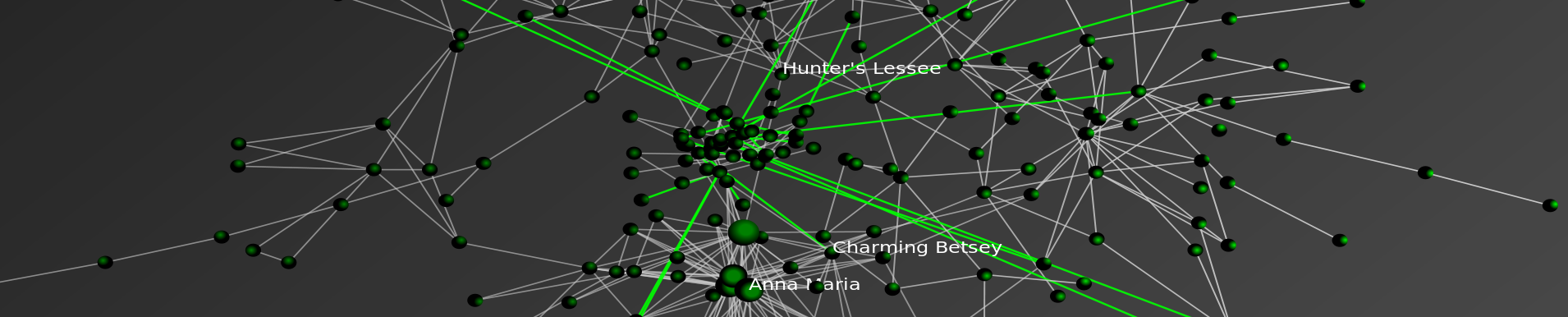
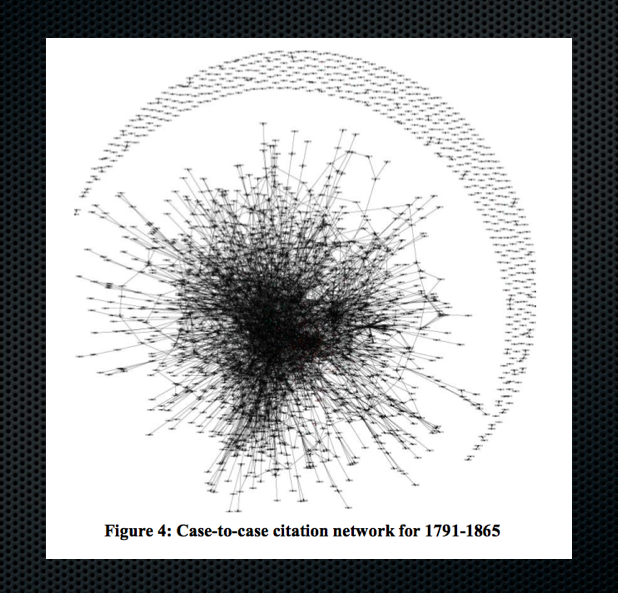
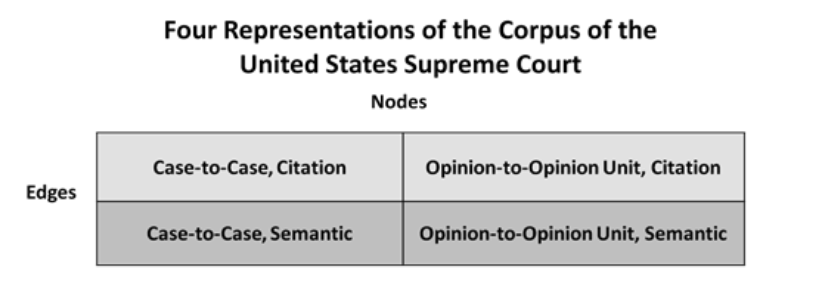
We have recently posted Law as a Seamless Web? Comparison of Various Network Representations of the United States Supreme Court Corpus (1791-2005) to the SSRN. Given this is the first of several posts about the paper, I will speak broadly and leave details for a subsequent post. From the abstract “As research of judicial citation and semantic networks transitions from a strict focus on the structural characteristics of these networks to the evolutionary dynamics behind their growth, it becomes even more important to develop theoretically coherent and empirically grounded ideas about the nature of edges and nodes. In this paper, we move in this direction on several fronts …. Specifically, nodes represent whole cases or individual ‘opinion units’ within cases. Edges represent either citations or semantic connections.” The table below outlines several possible network representations for the USSC corpus.
The goal of the paper is to do some technical and conceptual work. It is a small slice of broader project with James Fowler (UCSD) and James Spriggs (WashU). We recently presented findings from the primary project at the Networks in Political Science Conference. The main project is entitled The Development of Community Structure in the Supreme Court’s Network of Citations and we hope to have a version of this paper on the SSRN soon. In the meantime, we plan additional discussion of Law as a Seamless Web in the days to come.
Maitland’s phrase refers to legal history not law. That’s important because I, for one, do not see how law could exist except as embedded in an evolving network that has a past, present, and future.