Archive

Posts Tagged ‘Web 2.0’

Large Scale ( 130,000 + ) Zoomable Visualization of a Twitter Network

January 24th, 2010 dmartink 2 comments

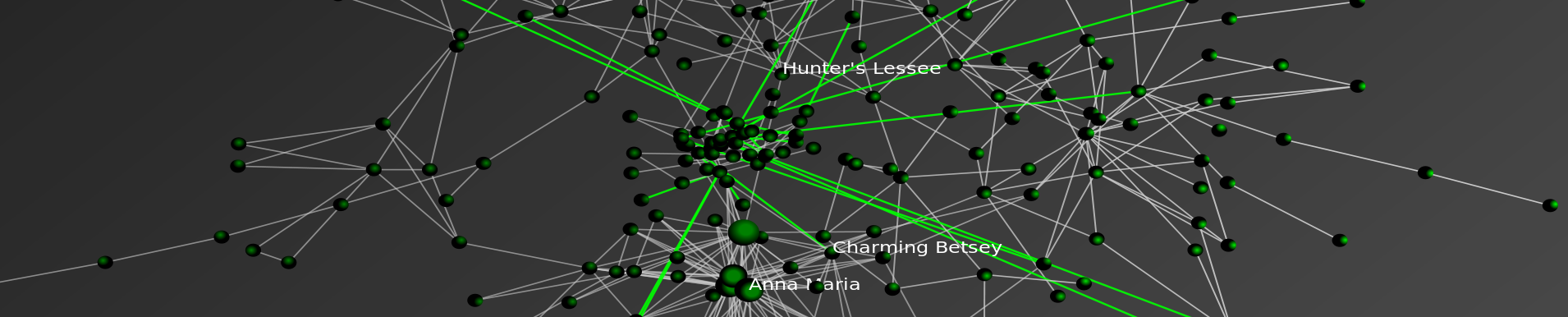
Starting with the Michael Bommarito’s twitter handle mjbommar, we built this visualization by collecting Mike’s direct friends, friends-friends, friends-friends-friends, etc. until we decided to stop …. just after passing 130,000 total twitter handles.  Using the Fruchterman-Rheingold algorithm, we visualized a network where |V| = 130365, |E| = 197399.

Those interested in reviewing some other twitter visualizations, please consult Nathan Yau at Flowing Data who has collected some of his favorites.  To our knowledge, the visualization we offer above is one the larger visualizations of twitter that have been produced to date. When you zoom in, you will notice we have flagged some of the celebrity twitter users we detected in the mjbommar friends-friends-friends, etc. network.  For example, as shown above Ashton Kutcher (aplusk), Chad Ochocinco (OGOchOCinco) and RainnWilson (rainnwilson) are contained therein.

Given the budget limitations of this blog, we cannot host this visualization in house. However, if you click the picture above, you can access the visual from Seadragon … a zoomable visualization platform from Microsoft Labs.

MIT Wins the Red Balloon Challenge

December 8th, 2009 dmartink No comments

Red Ballon

Google Wave — A Promising Platform for Real-Time Collaboration

November 23rd, 2009 dmartink No comments

communication_collaboration_google_wave_revolution_id793675_size485

Also from the good folks at Google Scholar comes caselaw and patents together with metadata, page tags and a nice “how cited” feature.  Here is the announcement from the GoogleBlog. Useful analysis available at Legal Informatics Blog, Just in Case and Internet for Lawyers. Enjoy!

Visualizing the Linkage Structure of the Law Blogosphere

November 22nd, 2009 dmartink No comments

Law Blogosphere

So this is Version 1.0 of our series regarding the linkage structure of the Law Blogosphere. We are currently working on a Version 2.0 that will feature documentation and a larger set of law blogs. Check back soon for more!

Broken Promises of Privacy: Responding to the Surprising Failure of Anonymization

November 3rd, 2009 dmartink No comments

Ohm on Privacy

On this blog, we have previously featured the work of Paul Ohm (Colorado Law School) including his important article Computer Programming and the Law: A New Research Agenda. Professor Ohm has recently posted Broken Promises of Privacy: Responding to the Surprising Failure of Anonymization, 57 UCLA Law Review ____ (forthcoming 2010). A review of SSRN downloads indicates that despite having been posted in just the last two months, this paper is the top downloaded new law paper posted to the SSRN in the past 12 months.

From the abstract: “Computer scientists have recently undermined our faith in the privacy-protecting power of anonymization, the name for techniques for protecting the privacy of individuals in large databases by deleting information like names and social security numbers. These scientists have demonstrated they can often “reidentify” or “deanonymize” individuals hidden in anonymized data with astonishing ease. By understanding this research, we will realize we have made a mistake, labored beneath a fundamental misunderstanding, which has assured us much less privacy than we have assumed. This mistake pervades nearly every information privacy law, regulation, and debate, yet regulators and legal scholars have paid it scant attention. We must respond to the surprising failure of anonymization, and this Article provides the tools to do so.”

YouTube Research — Robust Dynamic Classes Revealed by Measuring the Response Function of a Social System

July 9th, 2009 dmartink No comments

YouTube Research

Here at the CSCS Lab, we are working hard to finish up some projects.  In the meantime, we wanted to highlight one of our favorite articles, an article we previously highlighted on the blog. Some of you might ask “what does this have to do with law or social science?” (1) We believe the taxonomy outlined in this article could potentially be applied to a wide set of social phenomena (2) As we say around here, if you are not reading outside your discipline, you are far less likely to be able to innovate within your discipline. So we suggest you consider downloading this paper….

Wordle of the Declaration of Independence — Enjoy the 4th of July!

July 4th, 2009 dmartink No comments

Declaration of Independence (Wordle)

The Rise of the Data Scientist [From Flowing Data]

June 29th, 2009 dmartink 5 comments

Data Science

Earlier in the month, there was a very interesting discussion over at Flowing Data entitled the Rise of the Data Scientist. We decided to highlight it in this post because it raises important issues regarding the relationship between Computational Legal Studies and other movements within law.

As we consider ourselves empiricists, we are strong supporters of the Empirical Legal Studies movement. For those not familiar, the vast majority of existing Empirical Legal studies employ the use of econometric techniques. For some substantive questions, these approaches are perfectly appropriate. While for others, we believe techniques such as network analysis, computational linguistics, etc. are better suited.  Even when appropriately employed, as displayed above, we believe the use of traditional statistical approaches should be seen as nested within a larger process. Namely, for a certain class of substantive questions, there exists tremendous amounts of readily available data. Thus, on the front end, the use of computer science techniques such as web scraping and text parsing could help unlock existing large-N data sources thereby improving the quality of inferences collectively produced. On the back end, the use of various methods of information visualization could democratize the scholarship by making the key insights available to a much wider audience.  

It is worth noting that our commitment to Computational Legal Studies actually embraces a second important prong. From a mathematical modeling/formal theory perspective, at least for a certain range of questions, agent based models/computational models ≥ closed form analytical models. In other words, we are concerned that many paper & pencil game theoretic models fail to incorporate interactions between components or the underlying heterogeneity of agents. Alternatively, they demonstrate the existence of a P* without concern of whether such an equilibrium is obtained on a timescale of interest.  In some instances, these complications do not necessarily matter but in other cases they are deeply consequential.  

On the Road Again… Trip to Colorado Law School

June 8th, 2009 dmartink No comments

Colorado Law

We just finished a few very interesting days at Colorado Law School. Given the intersect of Computer Program and Law is a fairly narrow set, it was great to spend sometime time at CU Law School because its faculty features two scholars with a significant programming background — Paul Ohm and Harry Surden. 

In addition to discussing CLS, we participated in a workshop on New Institutional Economics (NIE) and Law. I found this workshop very interesting as outside of my work in Computational Legal Studies, I have authored scholarship at the crossroads of New Institutionalism and Constitutional Political Economy.  For example, I have this article and this work in progress. My work follows the tradition of the Bloomington School of NIE. In two weeks, I will be presenting work in progress at ISNIE in Berkeley. 

Following the Colorado NIE Workship, we participated in the Silicon Flatirons Government 3.0 roundtable. I do not want to preempt the forthcoming white paper but I will say that it was a very worthwhile discussion.  It solidified my views on some topics and changed my mind on some others. So, the road show continues… AI & Law in Barcelona starts tomorrow… so light blogging for the next week. But as I like to say… more to come… 

Computer Programming and the Law — OR — How I Learned to Learn Live with Python and Leverage Developments in Information Science

April 5th, 2009 dmartink No comments


picture-31


One of our very first posts highlighted a recent article in Science Magazine describing the possibilities of and perils associated with a computational revolution in the social sciences.  A very timely article by Paul Ohm (UC-Boulder Law School) entitled Computer Programming and the Law: A New Research Agenda represents the legal studies analog the science magazine article.  From information retrieval to analysis to visualization, we believe this article outlines the Computational Legal Studies playbook in a very accessable manner.

Prior to founding this blog, we had little doubt that developments in informatics and the science associated with Web 2.0 would benefit the production of a wide class of theoretical and empirical legal scholarship. In order to lower the costs to collective action and generate a forum for interested scholars, we believed it would be useful to produce the Computational Legal Studies Blog. The early results have been very satisfying. For example, it has helped us link to the work of Paul Ohm.  

For those interested in learning more about not only the potential benefits of a computational revolution in legal science but also some of the relevant mechanics, we strongly suggest you consider giving his new article a read!  

WP SlimStat