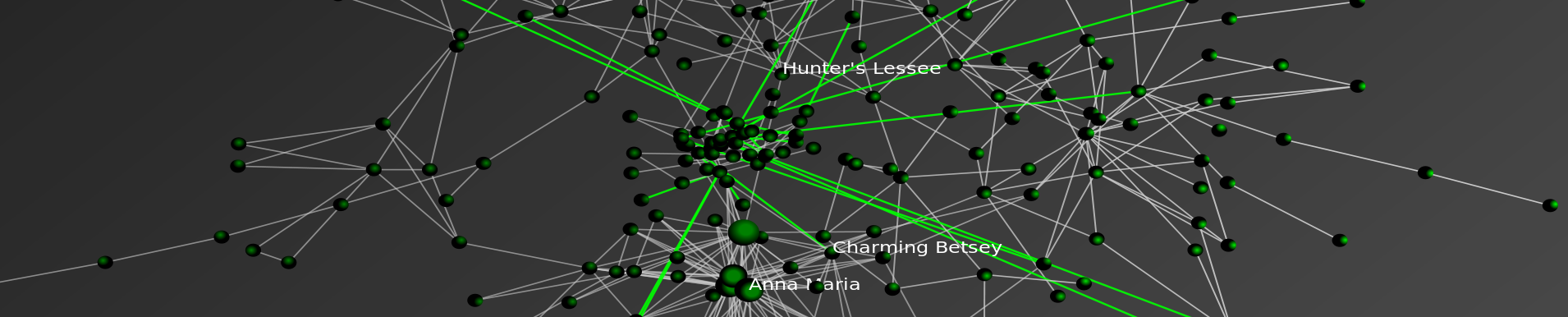
From the abstract… “The mechanisms driving the nucleation, spread, and dissipation of crime hotspots are poorly understood. As a consequence, the ability of law enforcement agencies to use mapped crime patterns to design crime prevention strategies is severely hampered. We also lack robust expectations about how different policing interventions should impact crime. Here we present a mathematical framework based on reaction-diffusion partial differential equations for studying the dynamics of crime hotspots. The system of equations is based on empirical evidence for how offenders move and mix with potential victims or targets. Analysis shows that crime hotspots form when the enhanced risk of repeat crimes diffuses locally, but not so far as to bind distant crime together. Crime hotspots may form as either supercritical or subcritical bifurcations, the latter the result of large spikes in crime that override linearly stable, uniform crime distributions. Our mathematical methods show that subcritical crime hotspots may be permanently eradicated with police suppression, whereas supercritical hotspots are displaced following a characteristic spatial pattern. Our results thus provide a mechanistic explanation for recent failures to observe crime displacement in experimental field tests of hotspot policing.”
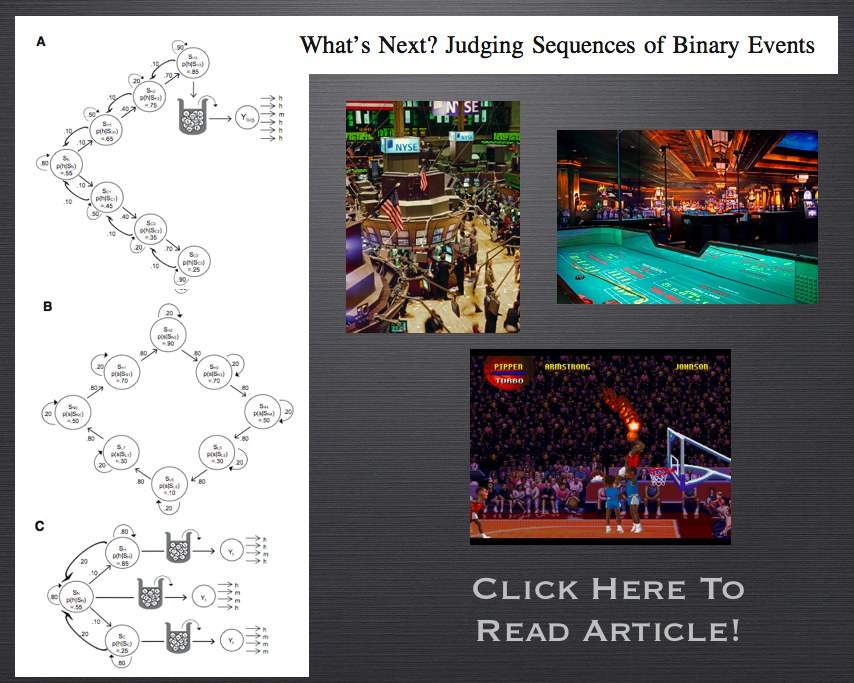
From the abstract … “The authors review research on judgments of random and nonrandom sequences involving binary events with a focus on studies documenting gambler’s fallacy and hot hand beliefs. The domains of judgment include random devices, births, lotteries, sports performances, stock prices, and others. After discussing existing theories of sequence judgments, the authors conclude that in many everyday settings people have naive complex models of the mechanisms they believe generate observed events, and they rely on these models for explanations, predictions, and other inferences about event sequences. The authors next introduce an explanation-based, mental models framework for describing people’s beliefs about binary sequences, based on 4 perceived characteristics of the sequence generator: randomness, intentionality, control, and goal complexity. Furthermore, they propose a Markov process framework as a useful theoretical notation for the description of mental models and for the analysis of actual event sequences.”
“Blaise Aguera y Arcas is an architect at Microsoft Live Labs, architect of Seadragon, and the co-creator of Photosynth, a monumental piece of software capable of assembling static photos into an interactive three-dimensional space. This seamless patchwork of images can be viewed via multiple angles and magnifications, allowing us to look around corners or “fly” in for a (much) closer look ….”
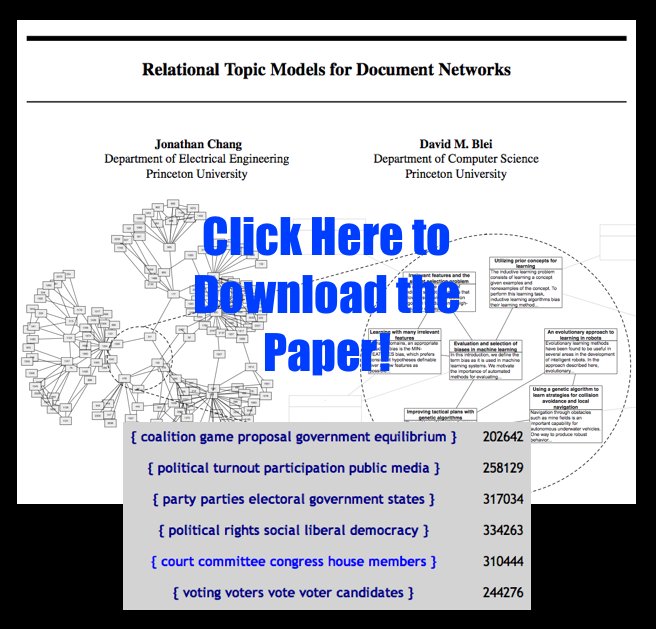
This is a very important paper by Jonathan Chang and David Blei. Suffice to say, it has potential use in a wide class of social science applications. Click here to access related material on Professor Blei’s Princeton homepage. Click here for some slides (note 7.0 mb). Check it out!
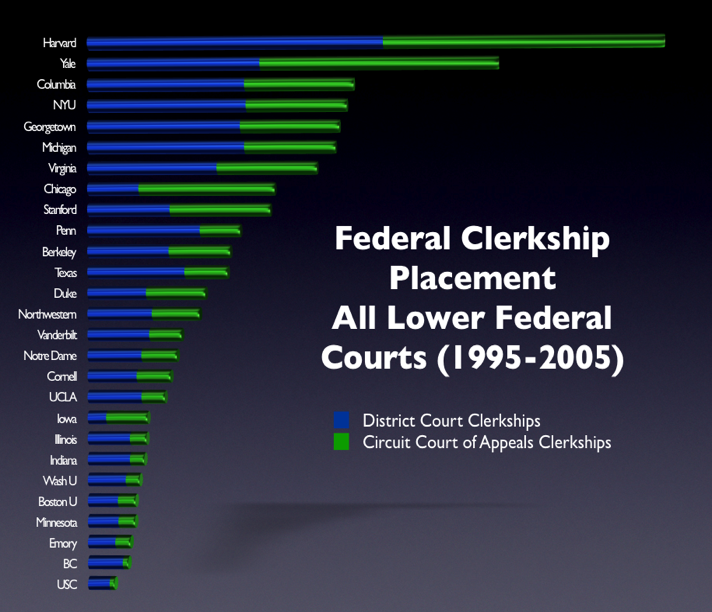
It is important to note the above data is merely the raw data. While we obviously could threshold for number of graduates per school, we choose not to do so because we do not have any particular theoretic reason to believe that placements linearly scale to differences in size of graduating classes. In other words, given we do not know the proper functional form — we just offer the raw data. For those interested in other posts on this subject, please click on thelaw clerks tag. or the law schools tag.
“Statistical Visual thinking will one day be as necessary for efficient citizenship as the ability to read and write.” {Revised Version of H.G. Wells Quote }
(1) The Supreme Court’s increasing reliance upon its own decisions over the 1800-1830 window.
(2) The important role of maritime/admiralty law in the early years of the Supreme Court’s citation network. At least with respect to the Supreme Court’s citation network, these maritime decisions are the root of the Supreme Court’s jurisprudence.
The Development of Structure in the SCOTUS Citation Network
The visualization offered above is the largest weakly connected component of the citation network of the United States Supreme Court (1800-1829). Each time slice visualizes the aggregate network as of the year in question.
In our paper entitled Distance Measures for Dynamic Citation Networks, we offer some thoughts on the early SCOTUS citation network. In reviewing the visual above note ….“[T]he Court’s early citation practices indicate a general absence of references to its own prior decisions. While the court did invoke well-established legal concepts, those concepts were often originally developed in alternative domains or jurisdictions. At some level, the lack of self-reference and corresponding reliance upon external sources is not terribly surprising. Namely, there often did not exist a set of established Supreme Court precedents for the class of disputes which reached the high court. Thus, it was necessary for the jurisprudence of the United States Supreme Court, seen through the prism of its case-to-case citation network, to transition through a loading phase. During this loading phase, the largest weakly connected component of the graph generally lacked any meaningful clustering. However, this sparsely connected graph would soon give way, and by the early 1820’s, the largest weakly connected component displayed detectable structure.”
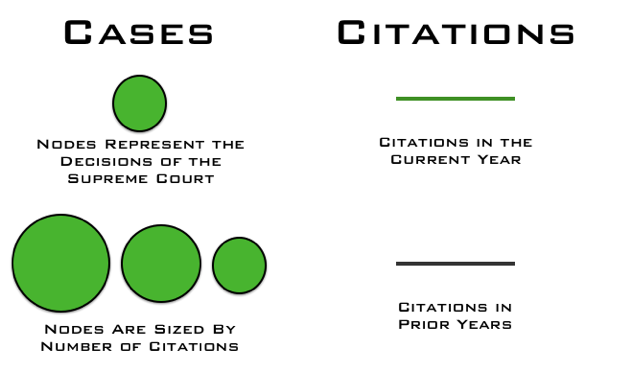
What are the elements of the network?
What are the labels?
To help orient the end-user, the visualization highlights several important decisions of the United States Supreme Court offered within the relevant time period:
Why do cases not always enter the visualization when they are decided?
As we are interested in the core set of cases, we are only visualizing the largest weakly connected componentof the United States Supreme Court citation network. Cases are not added until they are linked to the LWCC. For example, Marbury v. Madison is not added to the visualization until a few years after it is decided.
How do I best view the visualization?
Given this is a high-definition video, it may take few seconds to load. We believe that it is worth the wait. In our view, the video is best consumed (1) Full Screen (2) HD On (3) Scaling Off.
Where can I find related papers?
Here is a non-exhaustive list of related scholarship:
(1) The Supreme Court’s increasing reliance upon its own decisions over the 1800-1830 window.
(2) The important role of maritime/admiralty law in the early years of the Supreme Court’s citation network. At least with respect to the Supreme Court’s citation network, these maritime decisions are the root of the Supreme Court’s jurisprudence.
The Development of Structure in the SCOTUS Citation Network
The visualization offered above is the largest weakly connected component of the citation network of the United States Supreme Court (1800-1829). Each time slice visualizes the aggregate network as of the year in question.
In our paper entitled Distance Measures for Dynamic Citation Networks, we offer some thoughts on the early SCOTUS citation network. In reviewing the visual above note ….“[T]he Court’s early citation practices indicate a general absence of references to its own prior decisions. While the court did invoke well-established legal concepts, those concepts were often originally developed in alternative domains or jurisdictions. At some level, the lack of self-reference and corresponding reliance upon external sources is not terribly surprising. Namely, there often did not exist a set of established Supreme Court precedents for the class of disputes which reached the high court. Thus, it was necessary for the jurisprudence of the United States Supreme Court, seen through the prism of its case-to-case citation network, to transition through a loading phase. During this loading phase, the largest weakly connected component of the graph generally lacked any meaningful clustering. However, this sparsely connected graph would soon give way, and by the early 1820’s, the largest weakly connected component displayed detectable structure.”
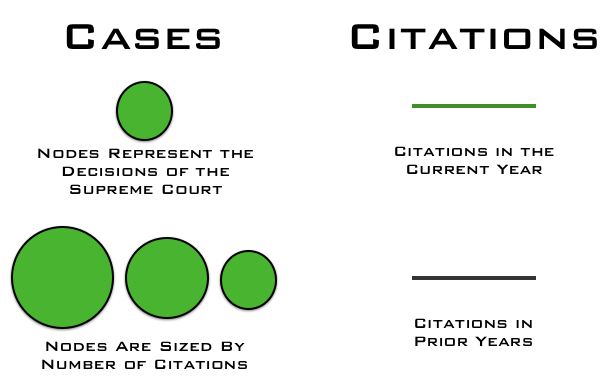
What are the elements of the network?
What are the labels?
To help orient the end-user, the visualization highlights several important decisions of the United States Supreme Court offered within the relevant time period:
Why do cases not always enter the visualization when they are decided?
As we are interested in the core set of cases, we are only visualizing the largest weakly connected componentof the United States Supreme Court citation network. Cases are not added until they are linked to the LWCC. For example, Marbury v. Madison is not added to the visualization until a few years after it is decided.
How do I best view the visualization?
Those interested in viewing the full screen video—click on the full screen icon contained in the Vimeo bottom banner. Check out the NEW Hi-Def (HD) version of the video!
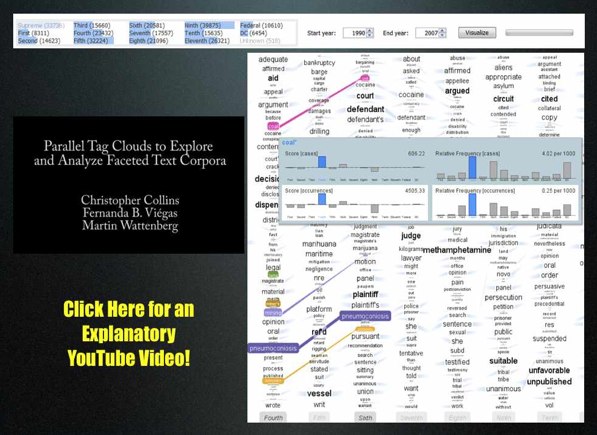
Download the paper: Collins, Christopher; Viégas, Fernanda B.; Wattenberg, Martin. Parallel Tag Clouds to Explore Faceted Text CorporaTo appear in Proceedings of the IEEE Symposium on Visual Analytics Science and Technology (VAST), October, 2009. [Note: The Paper is 24.5 MB]
Here is the abstract: Do court cases differ from place to place? What kind of picture do we get by looking at a country’s collection of law cases? We introduce Parallel Tag Clouds: a new way to visualize differences amongst facets of very large metadata-rich text corpora. We have pointed Parallel Tag Clouds at a collection of over 600,000 US Circuit Court decisions spanning a period of 50 years and have discovered regional as well as linguistic differences between courts. The visualization technique combines graphical elements from parallel coordinates and traditional tag clouds to provide rich overviews of a document collection while acting as an entry point for exploration of individual texts. We augment basic parallel tag clouds with a details-in-context display and an option to visualize changes over a second facet of the data, such as time. We also address text mining challenges such as selecting the best words to visualize, and how to do so in reasonable time periods to maintain interactivity.
From the Abstract … “The race is on to build a computer that exploits quantum mechanics. Such a machine could solve problems in physics, mathematics and cryptography that were once thought intractable, revolutionizing information technology and illuminating the foundations of physics. But when?” (Subscription may be required for Access)